
 Seeds
Seeds

















 Growshop
 Nutrients








 Extractions
 CBD
CBD
 Magic Mushrooms
 Headshop
Few cannabis varieties have generated as much buzz, as many conflicting versions, and as many grower bar theories as Toad Venom. In just two or three years, this hybrid went from being an anonymous plant among thirty seeds germinated in Los Angeles to becoming one of the most sought-after, counterfeited, and discussed clones in the American market, with cuttings that in some illicit markets have been sold for thousands of dollars. But behind the hype there's a genuinely tangled origin story, with at least two breeders claiming part of the credit, a controversial name change, a genetics substitution scandal, and, as often happens in the cannabis world, several competing theories without any official technical document yet to settle the dispute.

This article reconstructs, from specialized sources, industry media (Leafly, Weedmaps, GreenState, Vice, MiCannaCast, Leaf Magazines, among others) and accounts from growers and seed banks, the origin of Toad Venom: where it comes from genetically, who created it, how it was first called "Becky", why it ended up being called "toad venom" and what's true about the parallel stories of Frog Poison and Detroit Runtz.
Added to this media account is also the firsthand testimony of the protagonists themselves: in a long podcast-format interview, Jake (from Ronin Seeds) and Glenn (from Green Dragon) reviewed the entire story together from their point of view. That conversation, listened to and shared by a breeder consulted for this article, agrees in essence with the version already circulating in media, but clarifies or corrects several specific points that had been simplified with successive repetitions on social media and the internet. Throughout the text, these nuances are noted where they appear.
Genetics of Toad Venom
The most repeated and best-documented version places the genetic origin of Toad Venom in the cross between Animal Face and Sin Mintz. Animal Face, bred by Seed Junky Genetics from Face Off OG x Animal Mints, brings to the mix dense resin production, vertical vigor, and that earthy fuel note so characteristic of OG and chem lines. Sin Mintz, on the other hand, descends from the cross between Sin Mint Cookies (from Sin City Seeds) and Zkittlez, and is responsible for the sweet, mentholated, and fruity profile that defines the initial smell of the flower, before the notes of gas and pine appear on the exhale.
In the interview with Jake and Glenn, this genetic is described even more precisely: Animal Face would have acted as the mother plant (female) and the pollen would come from a male of Sinmint Cookies / Sin Mintz, a line they directly link to the Zkittlez x Thin Mint Cookies cross (the "thin mint" phenotype of Girl Scout Cookies from which much of the Sin Mint family originates). Jake also explains, according to that account, where the seeds physically came from: they would have arrived from Battleground, in Washington state, already as the Animal Face (from Seed Junky) x Sinmint Cookies cross, without going through any other intermediate lineage.

This is relevant because Leafly, one of the most consulted strain databases, lists a completely different lineage for Toad Venom: Venom OG x All Gas OG. According to the same breeder consulted, in the interview Jake explicitly refutes this alternative genealogy and attributes it to a confusion or misrecording that has been repeated. Even so, it's wise to be prudent: as long as there is no official technical publication that settles the question in a public and verifiable way, the most honest approach is to present both versions and indicate which one is defended directly by those who claim to have made the cross. In a market where lineage certificates are often as informal as a social media post, word of mouth among growers or, as in this case, a podcast interview, it's common for several versions of the same genetic story to circulate, each one defended by a different group within the community.
From the 2021 "pheno hunt" comes "Becky"
The most cited origin story, and the one with the most narrative detail, begins in 2021. According to accounts from both GreenState and Vice, as well as the 1321 store, an intermediary delivered seeds produced by Ronin Seeds (based in Los Angeles) to the Green Dragon facilities in North Hollywood. There, a grower identified as Glen S. and his team germinated seeds in search of an outstanding phenotype, the process known in cultivation jargon as a "pheno hunt".
The Green Dragon team internally named the winning plant "Becky", a colloquial nickname used in Southern California to refer, with a hint of irony, to young women from the San Fernando Valley. Glen S. summed it up this way in an interview cited by GreenState:
"She was the true outlier in that bunch".
A later article synthesized the origin myth into a single sentence that has circulated widely among growers: "One keeper out of thirty seeds. That's the whole legend in a sentence." It is precisely this point that the consulted breeder highlights as one of those that has been most simplified over time: according to what Jake and Glenn recount in the interview, the actual selection at Green Dragon was considerably broader than the phrase suggests, with around 170 phenotypes worked in parallel, not thirty seeds with a single survivor. The figure "thirty seeds, one keeper" would be more of a polished narrative repeated after the facts than a literal description of the selection process as its protagonists remember it. Green Dragon began marketing "Becky" in 2022, with distinctive packaging that quickly became recognizable in California dispensaries.
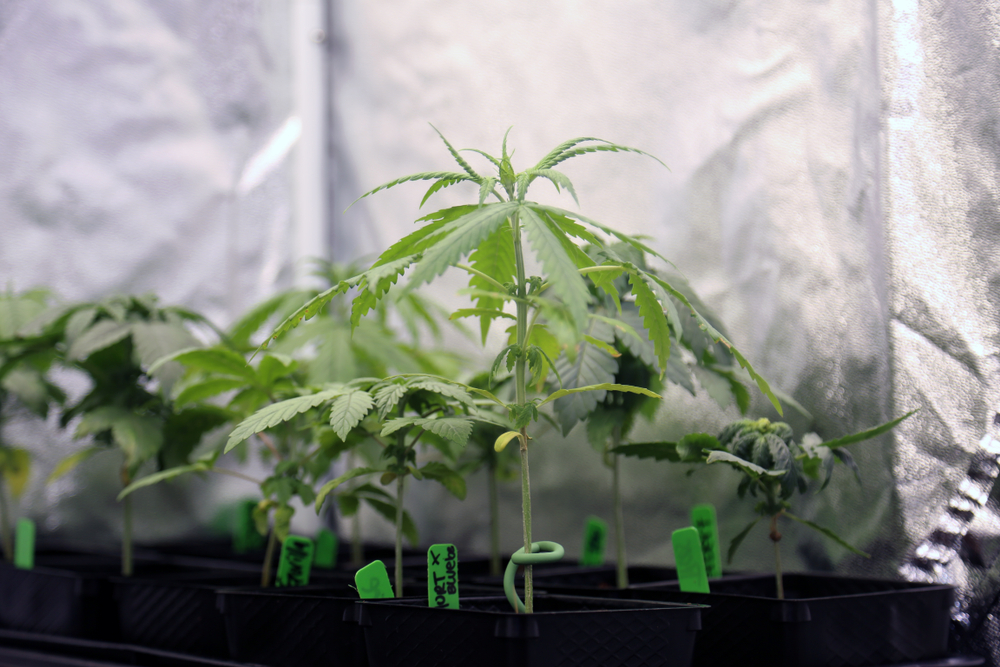
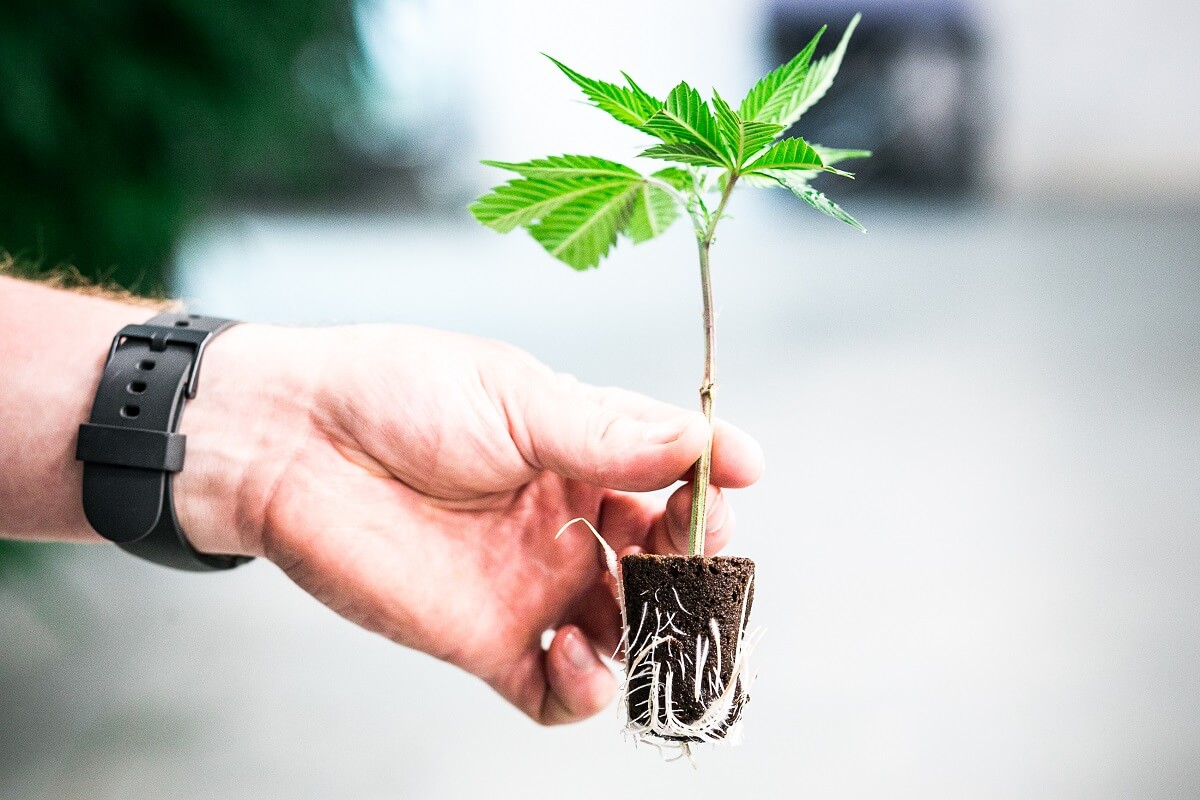
Pheno Hunting, how to find the plant of your life among a handful of seeds
Discover what pheno hunting is, why to do it, and how to select step by step the best phenotype among your seeds to preserve it as a mother plant.
From "Becky" to "Toad Venom"
This is where the story branches off and where the real community debate begins. According to several coinciding sources (GreenState, Vice, Weedmaps), at some point in 2022 plant material from "Becky" left Green Dragon's facilities without authorization and ended up in a Ronin Seeds project in Oklahoma. Glen S. was emphatic about this:
"I can say that it wasn't allowed. They took it out [of the facility]."
It's worth clarifying, however, how this episode is told firsthand. According to the breeder consulted based on the interview with Jake and Glenn, the matter doesn't simply boil down to "someone stole the plant": between Green Dragon and Ronin Seeds there was already a prior relationship (it was precisely Ronin who had provided the original seeds), and in the transfer of the cut a third party appears as intermediary, Derek, within a network of contacts and collaborations much more tangled than a simple theft. Glenn maintains that he, personally, did not authorize the cut to leave the premises, so there was a real problem of management and trust; but Jake himself frames the whole matter with an idea he repeats often, and which was already captured at the time by the Mango After Hours podcast: cannabis clones function, he says, like "open source code" (a kind of "open source" that historically has been passed from hand to hand among breeders and growers without clear ownership rules existing), although he acknowledges that losing credit for someone's selection work hurts. Put another way: there was a real conflict, but the firsthand version describes it more as a gray area typical of how genetics have always moved in this world, than as a straightforward theft with a single culprit.
It was already at Ronin Seeds where, according to this version, the plant was renamed Toad Venom, alluding to what is described as its "sinful animal nature". Press sources usually attribute the name change to "a Ronin employee", generically, but the breeder consulted specifies, following what Jake says in the interview, that it was specifically Dusty, one of the guys from the cultivation room of the Oklahoma project, who launched the question that triggered everything: "What's a sinful animal?" From that brainstorming session came the toad, and from there "the toad's venom".
It's worth noting, as a cultural curiosity, that the name also resonates with a real and very different phenomenon: the practice of smoking the secretion of certain desert toads (like the Sonoran Desert toad, Incilius alvarius), rich in 5-MeO-DMT, a psychedelic substance that has nothing to do with cannabis but shares headlines with it ("toad smoking uses venom from angry amphibian to get high," Fox News headlined in another context, and even boxer Mike Tyson has spoken publicly about his consumption of "toad venom" in that literal sense). This coincidence of names has generated no small amount of confusion among those who hear about "Toad Venom" for the first time without knowing whether it refers to a cannabis variety or a ritual with amphibian secretion; cultivation forums themselves often joke about this misunderstanding, although there's no evidence that the variety's name was directly inspired by that practice.
Regarding the core of the conflict, there are two opposing interpretations that coexist in the community. Green Dragon maintains that Ronin Seeds appropriated someone else's phenotypic selection work and took credit that didn't fully belong to them. From Ronin's side, the position is more ambiguous, supported by that "open source" logic already mentioned. No publication, not even the firsthand interview, definitively resolves who is right, and probably never will: in the world of cannabis cuts, ownership is measured more in reputation and marketing ability than in contracts.
The Detroit Runtz Scandal
The origin controversy didn't end with the name change. According to Vice, at some point the Oklahoma cultivation project distributed what was actually Detroit Runtz, a different variety, as "Toad Venom," in what is described as an apparently intentional substitution. Roots Cannabis Nursery, a clone bank that published a guide to detect fake cuts, confirms having seen "growers who have flowered entire rooms of 'Toad Venom' that turned out to be Detroit Runtz."
Not all press sources treat this episode with the same degree of certainty: MiCannaCast, a specialized podcast, is much more cautious and explicitly warns that the so-called "Detroit Runtz rumor" should not be treated as confirmed fact, but as "unverified market conversation." However, according to the breeder consulted, in the interview with Jake and Glenn this point ceases to be just a rumor: Jake himself confirms it directly and also explains his own role in the matter. He recounts that, in the context of the struggle to obtain the Oklahoma cuts without going through him, he himself came to deliver Detroit Runtz and some other material with a similar profile (orange, mint notes, etc.) to West Coast Alchemy and Cutright. In other words: the firsthand version not only confirms that Detroit Runtz circulated labeled as Toad Venom, but also places Jake as an active part of that move, in a maneuver within the dispute itself for control of the cut and not as a simple confusion or external scam.

This divergence between what some media treat as rumor and what the protagonists themselves acknowledge in the interview is, in itself, revealing of how information works within cannabis culture: much of what is taken as the "official history" of a variety is built from rumors, Instagram posts and secondhand testimonies, and only sometimes, as in this case, does it end up being confirmed (or nuanced) by those who were inside.
To detect a fake cut, Roots Cannabis Nursery recommends looking for several traits: in vegetative phase, a compact structure with tight internodes (inherited from Sin Mintz) and a sharp mint and citrus aroma when rubbing the stem; in flowering, abundant trichome coverage, an aroma that evolves from electric mint to lime and green citrus before finishing with gas and pine, a deep forest green color with subtle purple hints (intense purple would indicate another variety), and a flowering cycle of 60 to 65 days, as plants that take a full ten weeks are probably not authentic.
Frog Poison: sister genetic branch, resurrection, or simple relabeling?
Closely linked to Toad Venom appears another variety, Frog Poison (sometimes spelled "Frawg Poison"), and here several different theories about its origin clash again. The 1321 store maintains that Frog Poison shares the same base genetics, Animal Face x Sin Mintz, and that it has been distributed by growers like Green Dawg Cultivators and NorthBay Gardens as a parallel branch of the same genetic tree, rather than as a variety derived from a specific incident.
Vice offers, on the other hand, a different and more dramatic narrative: after the substitution episode with Detroit Runtz, a cut believed to be the authentic original Toad Venom was recovered from backup plant material in Colorado. That material was renamed Frog Poison, a name chosen both as a nod to the original variety and as a veiled critique of the drama surrounding it.
The version provided by the consulted breeder, based on the interview with Jake and Glenn, is actually simpler than the previous two: Frog Poison would have been, above all, the name that West Coast Alchemy started using to continue commercially moving that material once the relationship with Ronin Seeds was broken, rather than the result of a different genetic or a heroic rescue of backup material. That is, more of a rebranding or a commercial continuity of the conflict itself than a new phenotypic selection. This account actually fits with what can be verified in the market: among the Frog Poison products in circulation appears, for example, a "Full Melt" rosin signed as a collaboration between West Coast Alchemy and Cutright Cannabis, precisely the two names that, according to this version, remained on Ronin's side when the genetics were disputed in Oklahoma. None of the three theories are necessarily entirely mutually exclusive, but again, it's the version from the protagonists themselves that appeals least to legend and most to a rather prosaic business explanation.
The "toadal chaos", the fever of May 2026
If anything confirms that Toad Venom ceased to be a simple niche variety, it was what happened in May 2026, an episode that Jake, from Ronin Seeds, described with the pun "toadal chaos" (a play on words between "total chaos" and "toad"). According to Leaf Magazines in their article "Hot Toad Summer", on May 10th Ronin Seeds released two hundred clones of the variety, and a week later, on May 17th, Green Dragon distributed several hundred more. The result was lines of growers arriving from New York, Spain and other points on the map to get their hands on a cutting.

Glen S. summarized the phenomenon with a phrase that has become almost an unofficial motto of the variety: "Everything about this strain has been weird." Jake, for his part, acknowledged the emotional weight of the journey: "It's been part of some of the highest highs and lowest lows of my life," though he also celebrated the diversity of phenotypes that emerged: "There's a ton of different expressions. It's just the coolest thing ever." The Leaf Magazines article itself compares the phenomenon to the plot of Jurassic Park: a genetics with such superior "fitness," in terms of demand and reputation, that it proved impossible to contain within a single breeder or a single grow room.
The hype was not without new victims of counterfeiting. A specialized bulletin reported, under the title "Curse of the Toad - Part II," how renowned grower Wizard Trees was affected by a fraudulent copy of the Toad Venom cut, forcing him to abandon an extensive and costly breeding project that had been underway for months.
From the Street to the Dispensary
The price escalation in the illicit market illustrates well the magnitude of the phenomenon: eighths moving between 120 and 150 dollars, pounds that on the east coast were paid between 4,000 and 10,000 dollars, cuttings that in San Diego reached 5,000 dollars in 2026, and even sales in Thailand at a price of about 150 dollars per 3.5 grams in 2025. GreenState also warns that to this day there are no verified and authentic sources of Toad Venom cuttings publicly available, which further fuels the myth of scarcity surrounding the variety.
At the same time, Toad Venom has been making its way into the legal market. Green Dragon distributes approximately 750 pounds every three months through Oakland-based KSS Distribution to nearly one hundred dispensaries in California, while Connected Cannabis Co. markets it through the Embarc chain. On the derivatives side, the Demon Toad variety, resulting from crossing Toad Venom with a Sin Mintz F2 line, was produced by Nature's Lab as cold-cured rosin (solventless) in one-gram format, distributed exclusively through a collaboration between Squintz and Foreign on Weedmaps, further expanding the commercial universe of the "Toad" family.
Thanks to the commercialization of clones, seeds can now be found such as those offered by Grower's Choice or the Philo Toad Venom version from Philosopher Seeds.

So, what is the real origin of Toad Venom?
With all of the above on the table, the honest answer is that there is still no single, closed, and verified account of the origin of Toad Venom, and it's unlikely that one will exist that satisfies all parties. What can be stated with reasonable certainty is that the variety was born from a cross between genetic lines of great prestige within California's "cookies/gas" scene (with Animal Face and Sin Mintz as the most repeated names), that it was selected through a classic pheno hunt of thirty seeds by the Green Dragon team in 2021, that it first circulated under the informal name "Becky," and that, after an unauthorized transfer of plant material to Ronin Seeds, it was renamed Toad Venom based on the question "what is a sinful animal?"
From there, the story becomes a case study on how hype is built in modern cannabis: rumors of genetic substitution, fake cuts that ruin entire harvests, parallel theories about sister strains like Frog Poison, queues of growers crossing countries for a cutting, and black market prices worthy of a collector's item. As the MiCannaCast article aptly summarizes, Toad Venom is, ultimately, a perfect example of "how modern cannabis hype really works," where buyers seek both a fascinating origin story and a good terpene profile, and where, in the absence of an official genetic registry, anecdotes, podcasts, and grower forums end up writing the legend.
Sources consulted
- GreenState – "Toad Venom is the hottest (and most debated) weed strain in 2026"
- Leafly – Toad Venom Weed Strain Information
- Weedmaps – "Toad Venom and Demon Toad: the genetics behind the drop"
- 1321 – "Toad Venom Strain: Becky, Ronin Seeds & the Frog Poison Debate"
- Vice – "Toad Venom: The Most Hyped Weed Strain of 2026"
- MiCannaCast – "Toad Venom Strain: Becky, Frog Poison, Genetics, Effects & Flavor"
- Roots Cannabis Nursery – "Toad Venom Strain: Is Your Cut the Real Deal?"
- Leaf Magazines – "Hot Toad Summer"
- David Downs Presents – "Leafly's Strain of the Year 2025, and a Fake Toad strikes again"
- Strainpedia – Toad Venom (Animal Face × Sin Mintz)
- Prime Cuts Nursery – Toad Venom Strain Grow Guide & Genetics