
 Seeds
























 Growshop
 Nutrients








 Extractions
 CBD
 Magic Mushrooms
 Headshop
List of contents
- What is freeze-drying?
- The advantages that made half the world dream
- Why do freeze-dried buds "lack something"?
- Does freeze-drying eliminate fungi and bacteria?
- Who is freeze-drying marijuana today?
- Freeze-drying ice or lator hash
- The problem of drying hash conventionally
- Advantages of drying hash with a freeze dryer
- Storage of freeze-dried hash once dry
- Freezing the harvest and freeze-drying on demand
- Do freeze-dried flowers oxidize?
- Is it worth freeze-drying homegrown cannabis?
- Sources:
The revolution that never quite happened? A few years ago, there wasn't a cannabis forum worth its salt without a thread about freeze-drying marijuana. Dry buds in 24 hours, terpenes intact, goodbye to mold… It seemed like drying racks and curing jars had their days numbered! And yet, today almost nobody talks about freeze-drying flowers, while freeze-drying has remained the undisputed queen of Ice or Lator hash. What happened along the way? Is it true that freeze-dried buds are "missing something"?
What is freeze-drying?
Freeze-drying (also known as lyophilization) is a dehydration technique that removes water without passing through the liquid state. First the flower is frozen and then, inside a vacuum chamber, the ice transforms directly into vapor, which is known as sublimation. The result is dry bud that retains its shape, color and a good part of its volatile compounds. The process is divided into three phases: freezing, primary drying (ice sublimation) and secondary drying or desorption, in which residual water bound to the tissues is removed. The vapor that is released ends up trapped in a condenser.

Benefits: traditional rack drying takes between 7 and 14 days, plus several weeks of jar curing. In contrast, a freeze-drying cycle for buds takes around 24–36 hours. Less time with the wet harvest means fewer days of risk and fewer sleepless nights worrying about mold.
The advantages that made half the world dream
The great promise of freeze-drying is the preservation of terpenes. Since there's no heat and water is removed as vapor at low temperature, the most volatile terpenes (myrcene, limonene, pinenes…) have fewer opportunities to escape. This translates into an aroma more similar to that of the living plant just before cutting.
When frozen, the resin heads become hard and brittle, but if the material is handled carefully they arrive intact at the end of the cycle. Additionally, the flower maintains its volume and color, something that in the American legal market was sold as an aesthetic plus for the dispensary shelf. And then there's the safety against mold, a dense bud hanging for two weeks in a poorly ventilated room is an invitation to botrytis. In a freeze-dryer, however, the flower goes from frozen to dry in a controlled environment. Less time humid equals less risk of losing entire harvests.
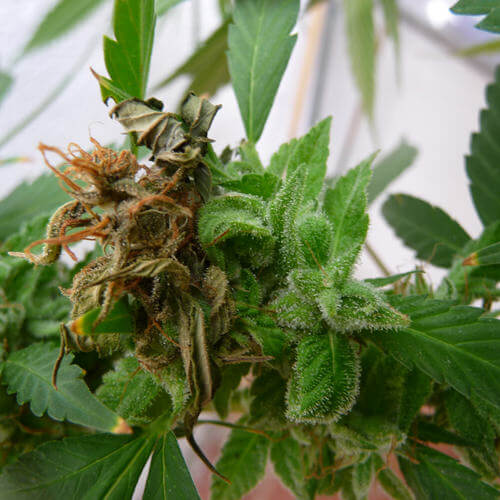
What is Botrytis or Gray Mold?
What is botrytis or gray mold? Which are the symptoms and how to avoid this fungal attack? Are there any strains especially resistant to botrytis? In this post you'll find all the iformation on this fungus, a common pest in cannabis plants.
Why do freeze-dried buds "lack something"?
The role of chlorophyll here is the key to the mystery. During a slow drying and a good cure, the plant remains "alive" at an enzymatic level for days, chlorophyll degrades little by little and part of the sugars and starches transform. That's why a well-cured bud loses that grass or hay flavor and lets the terpenes shine in their own light. Freeze-drying does just the opposite, freezes the flower at the moment of cutting and "pauses" all that chemistry. The enzymes that should break down chlorophyll don't have time or water to work, so the green pigment gets trapped. The result is buds of a very vivid green, beautiful in photos, but which in many cases leave a vegetal background and a harsher smoke than expected.
On top of this, there are other details that the most discerning cultivators notice right away. An over-freeze-dried flower ends up very dry and brittle, burns faster, and its porous structure causes terpenes to volatilize sooner once the container is opened. In fact, the first attempts with freeze-dryers designed for fruit resulted in fragile, brittle flowers with little flavor. That's why manufacturers of equipment specific to cannabis ended up adjusting time, temperature, and pressure to remove the flower with 11–12% moisture instead of leaving it at zero, and they even recommend a brief stabilization in a jar afterwards.

Does freeze-drying eliminate fungi and bacteria?
It's a very logical question: if the pharmaceutical industry freeze-dries, is it to leave the buds sterile? Well, not exactly. Freeze-drying does not kill most microorganisms. In fact, microbiology laboratories use it precisely to preserve strains of bacteria and fungi for years. What it does is remove the water they need to multiply, so it leaves them "dormant," not dead. What it does provide is a preventive advantage: by skipping the humid drying days, it greatly reduces the window in which mold can proliferate, resulting in less risk of a dense harvest spoiling. But if the material already arrived contaminated, the contamination will still be there.
In regulated medicinal cannabis, the usual tool to reduce microbial load is another one: irradiation is used (gamma rays, X-rays, or electron beam), widely used for example in the Netherlands or Canada. Studies indicate that it barely affects cannabinoids and has little effect on terpenes. Even so, recent research from McGill University warns that it doesn't achieve complete sterilization either.
Who is freeze-drying marijuana today?
In the United States and Canada, freeze-drying flowers hasn't disappeared, but it has remained a niche. Some companies developed cannabis-specific machines (they call them "cryo cure" or "crop-to-cure") that promise to go from harvest to jar in one or two days. There are growers who use them to reduce mold risks or free up drying space. Even so, the bulk of the premium market continues to rely on slow drying and traditional curing, because that's what the discerning user recognizes as quality.

What is clear is where the industry has moved: toward fresh frozen, that is, freezing the fresh buds right after cutting to later extract live resin loaded with monoterpenes, and from there to water hash, the terrain where the freeze-dryer has become a true star.

Fresh Frozen cannabis extractions
Cannabis concentrates made from fresh frozen plant material are more popular everyday. In this post we tell you how to make this high grade marijuana extract easily at home, with the same materials used in any traditional ice water extraction.
Freeze-drying ice or lator hash
If there's one terrain where the freeze-dryer has gone from promise to essential, it's water hash (also known as ice-o-lator or bubble hash). Today it's hard to find a serious hashmaker who doesn't have one in the workshop, and it's no coincidence. We'll tell you why it works so well, how to do it step by step, and what alternatives you have if you haven't gotten one yet.

Harvest Right freeze dryers for drying hashish
Freeze dryers are being increasingly used to dry large amounts of ice water hash while retaining almost 100% of the terpenes present in the plant material. In this post, we introduce Harvest Right freeze dryers, a range of household freeze-drying machines that allow quick and perfect drying of your favourite resins.
Why is hash the perfect candidate? Water hash is formed almost exclusively of trichome heads, separated from the plant with ice water and screens of different sizes (microns). It barely contains any leaves or calyxes, so there's no chlorophyll that needs to break down with weeks of curing. The big "but" of freeze-drying buds, that vegetal background that gets trapped, simply doesn't exist here. Additionally, freshly washed resin comes out soaked, cold, and extremely fragile. The only thing it needs is to lose water as quickly as possible without heating up or oxidizing, and that's exactly what a freeze dryer does best. It seems like this machine was invented with hash in mind!
The problem of drying hash conventionally
Once the ice or lator is done, the classic drying method consists of crumbling the result and letting it dry in a cool room (also in a frost-free fridge). It works, but it can take one or two weeks depending on the layer thickness and environment, and requires good control of temperature and humidity. If you live in a warm or humid area, things get much more complicated. During all that time, the resin is exposed to oxygen, light, and temperature changes. The result is usually darker hash (that toasted tone reveals oxidation) and terpenes that evaporate. In the worst case, every hashmaker's nightmare appears: mold on material that has cost you hours of work and many grams of harvest.
Advantages of drying hash with a freeze dryer
The first major advantage is speed—a cycle for hash takes around a day and a half, compared to a week or more of air drying. Less time wet means less risk of mold and fewer chances for the resin to spoil.
The second advantage is quality, since by working cold and under vacuum, without oxygen or heat, the most volatile terpenes are better preserved and the resin maintains that light, almost blonde color that's so prized. The aroma comes out potent and true to the variety, something especially noticeable when the starting material is fresh frozen.
The third is the texture and consistency between batches. Freeze-dried hash comes out loose, granulated, and easy to handle, ideal for smoking as is, for high-end dabs (the legendary full melt), or for pressing to obtain live rosin. And since the machine always repeats the same program, each batch comes out just as good as the previous one.
Storage of freeze-dried hash once dry
Hash remains sensitive to oxygen, light, and heat. Store it in airtight and opaque containers, with as little air space as possible and in a cool place. Many hashmakers keep it in the freezer if they're not going to consume it soon, thus maintaining its aroma and color for much longer. If you store it cold, take out only the amount you're going to use and let it reach room temperature inside its closed container before opening it. This way you'll prevent ambient humidity from condensing on the resin. What if I don't have a freeze dryer? No problem, homemade ice-o-lator is still possible! An economical alternative is to dry the hash inside a frost-free refrigerator: the resin stays cool and protected from mold, although the process takes about 5–7 days.
Freezing the harvest and freeze-drying on demand
This is one of the "tricks" that circulates most among growers: freezing fresh buds immediately after harvest and freeze-drying them only when needed. The idea has merit, because cold greatly slows down the evaporation and oxidation of terpenes. Fresh frozen material can remain in very good condition for more than a year at stable sub-zero temperatures.
When frozen, the trichome becomes rigid like glass and breaks with any impact, so the bags should not be shaken or handled roughly. It's also not advisable to thaw before putting the material in the freeze dryer. Each freeze-thaw cycle breaks cells, condenses moisture on the flower, and opens the door to mold and aroma loss. And although cold slows down degradation, it doesn't stop it completely—even in the freezer, THC gradually degrades slowly over the years.
During the freeze-drying process itself, some of the most volatile terpenes also escape, especially if the cycle is extended or dried excessively; it's not a "zero-loss" process as it's sometimes marketed. For a home grower, freezing in vacuum-sealed bags in portions is perfectly viable. But a domestic freezer (around −18 °C, with constant openings) doesn't offer the same guarantees as a chest freezer at lower temperatures. If you're going to do it, a dedicated chest freezer that's opened infrequently is better.
Do freeze-dried flowers oxidize?
Freeze-drying leaves the flower with very little available water, and that's great news against mold. With a well-sealed container, the risk of fungi appearing during storage drops significantly. That's why one of the most highlighted advantages is its ability to be stored for long periods. However, freeze-drying doesn't stop the clock. Oxygen, light, and heat continue to act the same way, THC gradually transforms into CBN (which has a more sedative effect) and terpenes oxidize or evaporate. Additionally, freezing breaks down part of the cell walls, so freeze-dried flower is more porous and easily absorbs moisture from the environment. If you leave it in a jar you open daily, it can rehydrate or lose aroma faster than a traditionally cured bud.

Cannabinol (CBN): The Cannabinoid Against Insomnia
CBN or cannabidiol is a common cannabinoid found in marijuana which is mainly produced by the degradation of its main constituent, THC. Over the past years, the interest on this cannabinoid has skyrocketed due its amazing properties, among which sleep aid stands out. In this article you'll find everything you need to know about this compound.
In summary, a freeze-dried flower ages through the same pathways as any other, but with a different profile, less risk of mold, and more sensitivity to air once opened. The recipe for making it last is the same as always, if we take it to the extreme: airtight and opaque jars, minimal air space, a cool and dark place, and opening only when necessary. Your harvest will thank you!
Is it worth freeze-drying homegrown cannabis?
Let's be honest, for most home growers, freeze-drying buds isn't worth it. A domestic freeze-dryer from the most popular brands costs over €5,000 depending on size. You can process only a few kilos of fresh material per batch, in cycles of 20 to 40 hours. Add to that the electricity consumption, maintenance, and the space it takes up. Moreover, as we've seen, the result in flower doesn't always convince the most demanding palates. With a well-controlled drying process (darkness, gentle ventilation, stable temperature and humidity) and a few weeks of curing in glass jars, you get smoother and more rounded buds for a fraction of the cost.
Where the investment can make sense is if you make hash frequently or in large batches, if you grow in a very humid area where mold is a recurring nightmare, or if you share the equipment with other uses, such as preserving garden produce. In those cases, the freeze-dryer goes from whim to tool. And if you stick with the traditional method, in our shop you'll find everything you need to dry and cure like a professional: drying racks, dehumidifiers, curing bags and jars, and humidity control packs.


Freeze-drying is a brilliant technique... Freeze-drying marijuana wasn't an empty trend, it's a fast technology, safe against mold and capable of preserving many terpenes. But by freezing the flower at the moment of cutting it also stops the curing, leaves the chlorophyll in place and explains that "something" many people miss in the flavor. That's why today it shines especially in water hash, while slow drying still reigns in flower. If you're curious, experiment thoughtfully and compare a small freeze-dried batch with another cured in the classic style. Your nose will be the best judge!
Happy harvest!
Sources:
- Post-Harvest Operations to Generate High-Quality Medicinal Cannabis Products (Molecules, 2022)
- Effect of Gamma Irradiation on Cannabis Biomass (Molecules, 2023)
- Why “Clean” Cannabis May Not Be Clean (The Analytical Scientist, 2026)
- The Cold Cure (High Times)
- Drying & Curing Techniques (Grow Mag)
- Freeze Dryer vs Cryo Cure Freeze Drying Cannabis (Lyophilization World)
- How to Fresh-Freeze Cannabis (Cannabis Business Times)
- How to Properly Store Cannabis (Ed Rosenthal)
- Freeze Dryers (Hydrobuilder)
- How to Dry Bubble Hash (Trimleaf)
- Can You Dry Bubble Hash in a Freezer? (Trimleaf)
- Bubble Hash Making Equipment (Trimleaf)