
 Seeds
Seeds
























 Growshop
 Nutrients








 Extractions
 CBD
CBD
 Magic Mushrooms
 Headshop
List of contents
- Dogma Organics, the artisanal supersoil arriving from Italy
- What is a SuperSoil and why is watering with just water enough?
- The Dogma Organics range: four pieces of the same system
- SuperSoil 4 Components:
- Root Connection:
- Top Dress Flo:
- Zeolita Pure10:
- The complement: blackstrap molasses
- Before you start: substrate and water
- How to combine the Dogma Organics range phase by phase
- 1. Substrate preparation
- 2. Transplanting
- 3. Vegetative phase
- 4. Pre-flowering
- 5. Flowering
- 6. Harvest and substrate regeneration
- What format do you need? Two practical examples
- Example 1: indoor grow tent with four 25-liter pots
- Example 2: outdoor with four 100-liter pots
- Common mistakes when growing with SuperSoil
Can you imagine a grow where you (almost) say goodbye to the pH meter, EC meter, and bottles of liquid nutrients? A system where, from transplant to harvest, the only thing coming out of your watering can is water? It's not a lazy grower's dream: it's the philosophy of Dogma Organics, the Italian brand that has just landed at Alchimia.
In this article, we introduce you to the brand and explain the role each of its products plays. And, above all, we explain how to combine them phase by phase following the manufacturer's own protocol.

Dogma Organics, the artisanal supersoil arriving from Italy
Dogma Organics was born in Italy after more than a decade of testing and experimentation with natural raw materials. Its flagship product, the SuperSoil 4 Components, is handcrafted and combines 11 natural ingredients, all suitable for organic farming. The brand itself presents itself as the first European supersoil produced artisanally.
Its philosophy fits into one sentence they repeat in their guides: fertility is not applied, it is built. Instead of feeding the plant directly, Dogma prepares a soil full of life that does that work for you and releases nutrients gradually. The result? Fewer interventions, less risk of over-fertilizing, and a flavor and aroma profile that the brand places at the center of everything.
And there's a detail we love: in the Dogma method, the substrate isn't thrown away at the end of the season. It regenerates cycle after cycle, so the soil improves over time and your wallet thanks you for it. Old school in its purest form, but with lots of science behind it!
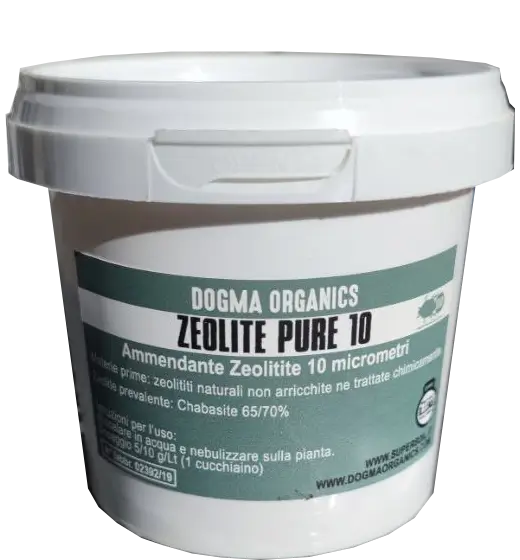
Zeolita Pure10 is finely micronized natural chabasite, a porous volcanic rock that Dogma Organics offers for foliar treatments without chemical agents. When spraye [...]
From
8.70€
10.90€
What is a SuperSoil and why is watering with just water enough?
A SuperSoil is a substrate enriched with slow-release organic nutrients and a good dose of beneficial microorganisms. If you want to delve deeper into the concept, in our post about how to prepare an organic Supersoil we explain it in detail.
The key is that the plant doesn't feed directly, but through the soil. Fungi, bacteria and other microorganisms break down organic matter and convert it into nutrients available to the root, which is known as the soil food web. That's why watering with just water is enough: the pantry is already in the pot and the microbial life is what manages it.
What do you gain from this? For starters, you forget about preparing nutrient solutions and measuring EC at each watering. Additionally, Dogma's SuperSoil incorporates components that help self-regulate pH, and the gentle, constant nutrition avoids the typical ups and downs of poorly adjusted liquid fertilizers.
The Dogma Organics range: four pieces of the same system
What's interesting about Dogma isn't just each product separately, but how they fit together. We present the four pieces you have available at Alchimia, each with its function within the system.
All are sold in two formats, Small and Big, so you can adjust your purchase to the size of your grow.
SuperSoil 4 Components:
The SuperSoil 4 Components is the foundation of the entire system. In the package you'll find four bags with the 11 elements necessary to transform a neutral substrate into a living, complete soil. It contains organic NPK fertilizer with plant compost, a natural calcium and magnesium corrector, mycorrhizae, rhizobacteria, trichoderma and humic and fulvic acids.
Translated into advantages: your plant has nutrients for the entire cycle and the calcium-magnesium corrector helps prevent deficiencies of these elements. Additionally, the included microbiology puts the soil to work from day one, and all of this with certification for organic farming.
It's available in Small 2.5 kg format, sufficient for about 100-110 liters of substrate, and in Big 10 kg format, which is good for between 400 and 480 liters. However, Dogma advises against using it in pots that are too small or together with synthetic fertilizers.
Root Connection:
If SuperSoil is the pantry, Root Connection is the network that connects the root to it. It's an inoculant with eight mycorrhizal species, saprophytic fungi such as Trichoderma harzianum and Pochonia chlamydosporia, bacteria from the Bacillus and Pseudomonas genera, and three varieties of Streptomyces. All of this is on a chabasite zeolite support.
And what does all this microscopic army do? It improves nutrient availability and absorption, so the plant grows more vigorously and tolerates water stress better. Additionally, it makes it more resistant to nematodes and pathogenic microorganisms and helps it overcome the dreaded transplant stress.
It's available in 210 g and 630 g formats, GMO-free and free of pathogenic organisms. In its original container, in a cool, dry place away from sunlight, it remains stable for a minimum of 18 months, so there's no rush to use it up.
Top Dress Flo:
Top Dress Flo is a concentrated organic preparation designed for flowering, the phase when the plant is most demanding. It contains NPK organic fertilizer with plant compost and a natural calcium and magnesium corrector with gradual release. It's spread on the substrate surface and then watered with just water.
Its function is to progressively refill the pantry and stimulate microbial activity, which is especially useful in medium or small pots and in very demanding plants. Watch out, because Dogma insists that it serves to prevent deficiencies, not to correct them urgently: applying it late is one of the most common mistakes.
The Small 0.4 kg format covers about 100-110 liters of SuperSoil and the Big 1.6 kg, about 400-440 liters. This quantity is divided into two applications during flowering, as you'll see in the protocol.
Zeolita Pure10:
The Zeolita Pure10 is natural Italian chabasite finely micronized, designed to spray on the leaves. It leaves a fine mineral coating adhered to the plant that works as a physical barrier against fungi and insects, without any chemical agent.
The great advantage is that it protects the aerial part without interfering with the soil life that you've worked so hard to build. However, it is a preventive treatment: it doesn't cure an already established pest, it doesn't provide nutrients and it's best not to apply it just before rain. If you want to know about the enemies it protects you from, take a look at our introduction to marijuana pests or our article about powdery mildew.
The dosage is 5 to 10 grams per liter of water. The 150 g format is enough to prepare between 15 and 30 liters of solution, and the 600 g, between 60 and 120 liters.
The complement: blackstrap molasses
The Dogma protocol includes a very simple ally: molasses. Its sugars are the perfect food for beneficial bacteria and fungi, so it activates the substrate's microbial life and keeps it in top shape throughout the entire cycle.
At Alchimia we recommend the organic sugarcane blackstrap molasses from Terralba, obtained from unrefined cane, certified for organic agriculture and easy to dissolve in cold water. Remember that it's an activator, not a fertilizer, and shouldn't be used with every watering: we'll detail the doses later on.
Before you start: substrate and water
Dogma recommends mixing SuperSoil with an unfertilized substrate made up of 60-80% peat and 20-40% coco fiber. It's the ideal base because it doesn't add extra nutrients and lets the SuperSoil set the pace.
If you prefer a ready-to-use commercial substrate, you have two options in our catalog. BioBizz Light Mix is the one recommended by several Dogma distributors. CoverCrop LightMix includes some coco and comes pre-inoculated with mycorrhizae and trichoderma (careful, it has nothing to do with Dogma's Cover Crop). Since it retains moisture well, dial in your watering carefully.
Keep in mind that both have a light pre-fertilization, so they're not exactly what the manufacturer indicates, although they are valid alternatives. Both are sold in 50-liter bags: you'll need about two bags for the SuperSoil Small and about eight for the Big. As for water, if yours is very hard or very alkaline, Dogma recommends mixing in 20 to 30% reverse osmosis or distilled water.
How to combine the Dogma Organics range phase by phase
Now we get to the juiciest part. We'll explain the complete protocol that Dogma proposes in their guides, adapted to the products you have at Alchimia. Take it as a guiding map rather than a rigid recipe, because biological timing varies depending on genetics, pot size, and environment.
The flowering schedule is designed for a variety of about nine weeks, so if yours is faster or slower, adjust the weeks to match its duration.
1. Substrate preparation
Dogma considers preparation the most important phase of the entire cycle, so it's worth taking your time. These are the steps:
- Mix the SuperSoil 4 Components with the neutral substrate in the proportion indicated on the package (as a reference, 1.25 kg per 50-60 liters) until you obtain a homogeneous mixture.
- Add Root Connection at a rate of 5 g per 10 liters of substrate and mix well again.
- Hydrate the substrate with settled water, little by little, with a sprayer or a very gentle watering can. It should be moist, but never saturated.
- Spray on top a solution of molasses at 0.5 ml/L to activate the microbial life.
- Transfer the mixture to the pots and compact it slightly. If you prefer, you can activate it all together and distribute it afterwards.
Here comes an important decision: to let it mature or not? If you're going to transplant plants with a small root system, Dogma recommends not pre-activating and letting the soil awaken gradually, at the same pace as the plant. On the other hand, if you transplant more developed plants, pre-activation will provide them with available nutrients from the very first moment.
In that case, let the substrate rest for a minimum of two weeks, ideally three to five, in the dark and between 18 and 24°C. Every 3-4 days check the moisture and, if necessary, add a little molasses at 0.5 ml/L. It will be ready when it smells like forest, has a spongy texture, and white mycelium appears on the surface. White mold? No need to worry, celebrate it!
2. Transplanting
Transplanting is the moment when Root Connection shines brightest, because it comes into direct contact with the root. Follow these steps:
- Fill the pots with the prepared substrate and open a hole the size of the root ball.
- Moisten the walls of the hole with water and molasses at 0.5 ml/L.
- Add 5-8 g of Root Connection per plant in the hole.
- Place the plant carefully, close and compact slightly.
- Give the first watering with water, molasses at 0.5 ml/L and Root Connection at 10 g/L.
Don't worry if during the first 5-10 days the plant seems stalled: it's a normal phase after transplanting. Maintain an ambient humidity of 60-70% and a temperature of 22-26 °C.
And, above all, don't overdo it with water. Dogma's golden advice is to water little and more often rather than a lot all at once, because excess water reduces substrate oxygenation and slows down microbial life.
3. Vegetative phase
During growth, the rule is to intervene as little as possible. Water using the lift-and-feel technique: lift the pot to feel its weight and water only when it's light. If all goes well, the substrate should dry out in 2-4 days.
From the second or third week onwards, add molasses at 1 ml/L once a week to keep the microbial life well fed. Also take advantage of this phase to protect the aerial parts with Zeolita Pure10 at 5-10 g/L and do it regularly, because Dogma points out discontinuous applications as one of the most common mistakes.
It's also a good time to apply training techniques such as LST. With a well-managed living soil, the plant responds with steady growth without setbacks.
4. Pre-flowering
Just before the photoperiod change, it's time to prepare the plant for its most demanding phase. These are the two key moves:
- Water with Root Connection at 10 g/L to strengthen the microorganism network before flowering.
- Make the last application of Zeolita Pure10, at 5-10 g/L.
Why say goodbye to zeolite so soon? It's very simple: from here on, flowers start to form and we don't want the mineral film to end up on your buds. If you still need protection, make the last application at the very latest at the start of flowering.
5. Flowering
The most exciting phase arrives and the one with maximum biological activity. The goal now is to maintain balance, so here's the roadmap week by week:
- Week 1: water only.
- Week 2: watering with molasses at 1 ml/L.
- Week 3: first half of Top Dress Flo on the surface and watering with Root Connection at 10 g/L.
- Week 4: a single watering with molasses; the rest, water only.
- Week 5: water only.
- Week 6: second half of Top Dress Flo.
- Week 7: water only.
- Week 8: water only.
- Week 9: water only and harvest.
To apply the Top Dress, spread it evenly over the substrate surface and water it so it gradually integrates. In pots smaller than 8 liters, Dogma recommends an extra application, as nutrient reserves deplete faster in smaller volumes.
Notice that molasses disappears in the final stretch: don't use it during the last week. And resist the temptation to add other fertilizers, because Dogma doesn't recommend them in its system: here, the soil rules!
6. Harvest and substrate regeneration
To know when to cut, observe the trichomes: they'll tell you when the moment has arrived. Afterwards, opt for a slow drying in darkness to preserve all those terpenes you worked so hard to achieve.
And don't throw away the substrate! In the Dogma method, the soil regenerates for the next cycle. Broadly speaking, you need to remove the roots, aerate the substrate well, reincorporate organic matter and SuperSoil, water with water and molasses, and let it rest in darkness for about 15-20 days.
According to the brand, a well-regenerated soil is usually richer and more reactive than the original, so each harvest can surpass the previous one. That said, don't skip the resting period or forget to replenish the SuperSoil, as these are the most common mistakes at this stage.
What format do you need? Two practical examples
To make it easier for you to choose, we present two typical grows and what you'd need in each case. These are guideline examples, so adapt them to your space and watering style.
The calculations are based on the doses indicated by Dogma for each product and the complete protocol you just saw.
Example 1: indoor grow tent with four 25-liter pots
In total we're talking about 100 liters of substrate, which you cover with the 2.5 kg SuperSoil Small and about two 50-liter bags of light substrate. The 0.4 kg Top Dress Flo Small fits that volume for the two flowering applications, and the 150 g Zeolita allows you to prepare between 15 and 30 liters of solution.
With Root Connection you need to do the math. The initial mix (50 g) and transplanting four plants (20-32 g) consume between 70 and 82 g of the 210 g container, and what remains is enough for 13-14 liters of solution at 10 g/L. Since the protocol includes three waterings with Root Connection, you'll most likely need a second container or find the 630 g format more economical.
Example 2: outdoor with four 100-liter pots
Here the volume rises to 400 liters, so you need to go with Big formats. You'll need the 10 kg SuperSoil with about eight bags of light substrate and the 1.6 kg Top Dress Flo, which covers around 400-440 liters. The 600 g Zeolita is enough for between 60 and 120 liters of solution.
Root Connection is again the product that gets consumed the most. The mix (200 g) and transplanting (20-32 g) take about 220-230 g from the 630 g container, and the rest is enough for about 40 liters of solution. With 100-liter pots and three waterings with Root Connection, plan on needing more than one container.
Common mistakes when growing with SuperSoil
Dogma's guides identify a series of mistakes that repeat over and over. The most frequent is overwatering, especially at the beginning. Close behind is watering by schedule instead of observing what the plant is asking for.
It's also common to force nutrition by adding liquid or synthetic fertilizers, using molasses with every watering, or applying Top Dress too frequently. In living soil, more is not better. Growing in pots that are too small for the plant size doesn't help either.
Lastly, don't confuse the roles of each product. Top Dress works better before deficiencies appear and zeolite doesn't serve to cure an already established pest problem. The golden rule of living soil is observe before correcting: many problems resolve themselves if the system is in balance.